
Heisman Trophy
Ticket Museum
This site is dedicated to the history of college football and its most coveted award...
The Heisman Memorial Trophy
which is presented annually to college football's most outstanding player.
The purpose of this site is to chronicle the college football season of every Heisman Memorial Trophy winner as illustrated through the beauty and artistry of game ticket stubs.
My goal is to collect a ticket stub, press pass, sideline pass, or any other form of entry to every regular season football game played during each Heisman Trophy winners Heisman Trophy winning season.
While I do prefer game ticket stubs over all other forms of entry, I will include others when I cannot find a ticket stub. I do add Bowl games and Playoff games, but they are not mandatory to the collection.
I am continually searching for the missing ticket stubs for this collection.
Please let me know if you have any of my needs available for sale or trade.
These missing tickets can be seen on each page identified with a "wanted" icon.
They can also be found in list form by clicking on the on the "TICKETS NEEDED" tab.
To date, I have acquired 869 of the 955 tickets (91%) necessary
to complete the collection between the years of 1935-2025.
Tickets beginning with the COVID-19 year of 2020 are very difficult to obtain as most schools and venues stopped printing tickets, instead going to digital formats.
I do not include any ticket from the COVID-19 year (2020) and going forward in the total
required for completion, unless I have obtained one and it as part of the collection.
That being said, on most occasion's they do exist in box office form.
I still try to obtain them when I am able to do so.
Please use the tabs below to view this collection by decade.
(for best viewing, I recommend using the desktop version, but a mobile version is also available)
I hope you enjoy this site as much as enjoy bringing it to you!
1960 Joe Bellino - Navy
Born and raised in Winchester, Mass., Bellino, nicknamed "The Winchester Rifle", was a three-sport star for Winchester High. He was good enough in baseball to be offered a contract out of high school by the Pittsburgh Pirates, but he chose to play football for Navy despite offers from Notre Dame and several Big Ten schools.
After a year in prep school, Bellino became an instant star for the Midshipmen. In his three years at Navy, he scored 31 touchdowns, rushed for 1,664 yards on 330 carries, returned 37 kicks for 833 more yards and altogether set 15 Naval Academy football records.In 1960, Bellino rushed for 834 yards and 15 touchdowns and scored another three touchdowns via pass receptions. He was a unanimous All-America selection and also the winner of the Maxwell Award. On November 29, 1960, he won the Heisman Trophy handily over Richie Lucas of Penn State, totaling 1,929 points to Lucas’ 613.

In addition to his football exploits, Bellino was an outstanding catcher and outfielder on Navy baseball teams. He hit .428 in 22 games in 1959 and led the Eastern Intercollegiate League in stolen bases. He had a .320 average in 1960 and was the baseball team captain in 1961.
Joe Bellino’s number 27 jersey was retired by Navy after the 1960 season. Bellino was selected in the 19th round of the 1961 AFL Draft by the Boston Patriots. He decided to join the Patriots of the American Football League, and played three seasons, primarily as a kick returner. Due to his five-year commitment to the U.S. Navy following graduation, he remains the lowest drafted Heisman Trophy winner in the history of the National Football League. He then stayed in the Navy Reserves and reached the rank of Captain.
Joe Bellino was inducted into the College Football Hall of Fame in 1977.
Joseph Michael Bellino
(March 13, 1938 - March 27, 2019)

9/17/1960 at Boston College
(W 22-7)
(attendance 25,000)

10/1/1960 at Washington
(W 15-14)
(attendance 57,379)

10/15/1960 vs. Air Force
(W 35-3)
(attendance 50,000)

10/29/1960 vs. Notre Dame
(W 14-7)
(attendance 63,000)

11/12/1960 vs. Virginia
(W 41-6)
(attendance 20,208)

9/24/1960 vs. Villanova
(W 41-7)
(attendance 20,271)

10/8/1960 vs. Southern Methodist (Oyster Bowl)
(W 26-7)
(attendance 30,000)

10/22/1960 at Pennsylvania
(W 27-0)
(attendance 26,123)

11/5/1960 at Duke
(L 10-19)
(attendance 46,000)

11/12/1960 vs. Virginia
(Press Pass)
(W 41-6)
(attendance 20,208)

11/26/1960 vs. Army
(Philadelphia Stadium)
(W 17-12)
(attendance 102,000)
1961 Ernie Davis - Syracuse
Born in New Salem, Penn., Davis moved to Elmira, New York, when he was 12 and soon revealed himself to be quite an athlete. He played baseball, basketball and football at Elmira Free Academy, earning high school All-American honors in the latter two sports. He was heavily recruited by some of college football’s top programs, but was swayed by NFL great Jim Brown, who convinced Davis that Syracuse, Brown’s alma mater, would be a welcoming place for a young black athlete. The 6-2, 211-pound Davis rushed for 686 yards and 10 touchdowns as a sophomore, earning the nickname “The Elmira Express” and the first of three All-America selections. Davis scored two touchdowns to help the Orangemen beat Texas, 23-14, in the Cotton Bowl as Syracuse won the national title.
yards.

On Novenber 28, 1961, Davis became the first African American ever to win the coveted Heisman Trophy. He won it after a season in which he gained 823 yards on 150 carries, averaging 5.5 yards per carry. He scored 15 touchdowns and totaled 94 points, leading Syracuse in pass receiving with 16 catches for 157 yards. After graduating from college, Ernie was drafted first overall by Washington in the 1962 draft, but quickly traded to the Cleveland Browns. He signed for the (then) astronomical sum of $80,000. Shortly after signing and before he suited up for his first pro game, Ernie was struck down by leukemia. He died on May 18 ,1963, after a sixteen-month battle for survival.
Ernie Davis was elected into the College Football Hall of Fame in 1979.
Ernest R. Davis
(December 14, 1939 - May 18, 1963)

9/23/1961 at Oregon State
(W 19-8)
(attendance 35,729)

10/7/1961 at Maryland
(L 21-22)
(attendance 35,000)

10/21/1961 at Penn State
(L 0-14)
(attndance 44,390)

9/30/1961 vs. West Virginia
(full student ticket)
(W 29-14)
(attendance 25,000)

10/14/1961 at Nebraska
(student ticket)
(W 28-6)
(attendance 35,387)

10/28/1961 vs. Holy Cross
(W 34-6)
(attendance 31,000)
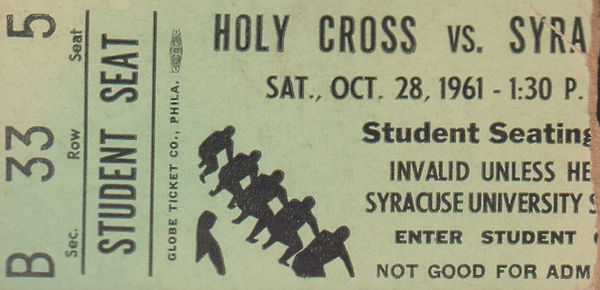
10/28/1961 vs. Holy Cross
(student ticket)
(W 34-6)
(attendance 31,000)

10/28/1961 vs. Holy Cross
(full student ticket)
(W 34-6)
(attendance 31,000)

11/4/1961 vs. Pittsburgh
(W 28-9)
(attendance 40,000)

11/4/1961 vs. Pittsburgh
(full student ticket)
(W 28-9)
(attendance 40,000)

11/11/1961 vs. Colgate
(W 51-8)
(attendance 25,000)

11/18/1961 at Notre Dame
(L 15-17)
(attendance 49,246)

11/25/1961 at Boston College
(W 28-13)
(attendance 17,600)

1961 Student Season Ticket Book (complete)
1962 Terry Baker - Oregon State
Born in Pine River, Minn., Baker attended Jefferson High in Portland, Ore., where he was a three-year letter winner in basketball and baseball. Football, however, was Baker’s most dominant sport. Baker played quarterback and tailback and led his team to a 23–0 record with two state titles in his last two seasons. Baker attended Oregon State where he played both basketball and football. On the gridiron, Baker was a talented dual-threat, passing for 863 yards and three touchdowns and rushing for 610 yards and five scores as a 1960 sophomore. As a junior, Baker threw for 875 yards and rushed for 375 and had a combined seven scores. As a senior in 1962, Baker threw for 1,723 yards and 15 scores and rushed for 538 yards and nine TDs as the Beavers finished 8-2 and ranked 16th in the polls.
On November 27, 1962, Baker won the Heisman Trophy for his achievements. He was the first player from a school west of Texas to win the award.

Terry Wayne Baker
(May 5, 1941)
In addition to winning the Heisman, he also won the Maxwell Award and the W. J. Voit Memorial Trophy, was a consensus first team All-American and was named the Sports Illustrated Sportsman of the Year. His Heisman in tow, Baker led OSU to a 6-0 victory over Villanova in the Liberty Bowl. The only score was Baker’s 99-yard touchdown run, which is still an NCAA record.But Baker wasn’t through with his college career at that point. He later joined the Beaver basketball team as a senior and averaged 13.4 points to help his team make the 1963 Final Four. He is still the only athlete to win the Heisman and appear in the NCAA Final Four in basketball. Baker graduated OSU with a degree in Mechanical Engineering in 1963 and then was selected as the first overall pick of that year’s NFL draft by the Los Angeles Rams. He played with the Rams for three seasons while earning a J.D. at USC’s Law School.
Terry Baker was elected to the College Football Hall of Fame in 1982.


9/29/1962 at Iowa
(L 8-28)
(attendance 54,400)
9/22/1962 vs. Iowa State
(Field Pass, ticket still wanted)
(W 39-35)
(attendance 30,430)

10/6/1962 at Stanford
(W 27-0)
(attendance 26,500)


10/13/1962 vs. Washington
(L 13-14)
(attendance 30,030)
10/27/1962 vs. West Virginia
(W 51-22)
(attendance 17,469)
10/20/1962 vs. College of the Pacific
(Field Pass, ticket still wanted)
(W 40-6)
(attendance 12,021)

11/3/1962 at Washington State
(W 18-12)
(attendance 16,500)


11/10/1962 at Idaho
(Field Pass, ticket still wanted)
(W 32-0)
(attendance 9,500)
11/24/1962 vs. Oregon
(W 20-17)
(attendance 28,447)
11/17/1962 vs. Colorado State
(Field Pass, ticket still wanted)
W 25-14)
(attendance 12,131)

12/15/1962 vs. Villanova
(Liberty Bowl)
(W 6-0)
(attendance 12,048)
1963 Roger Staubach - Navy
Known as “Roger the Dodger,” all Staubach did as a junior quarterback was lead Navy to a ranking of second in the country and a berth in the Cotton Bowl, where he set Bowl records for pass completions (21-of-31) and yards passing (228). The Midshipmen posted wins over West Virginia, Michigan, Notre Dame and Maryland that season. He completed 106 passes in 161 attempts for 1,474 yards, while earning consensus All-America honors, as well as the Maxwell Trophy and Walter Camp Memorial Trophy. On November 26, 1963 he was awarded the Heisman Trophy. At one time, Staubach, who was hampered by injuries in his senior season of 1964, had set 28 Naval Academy records in football. After four years in the U. S. Navy, including a tour in Vietnam, Staubach joined the Dallas Cowboys and led that team to unprecedented heights earning the nicknames "Captain America" and "Captain Comeback"

Roger Thomas Staubach
(February 5, 1942)
Again, displaying the daring play he had shown at Navy, Staubach directed the Cowboys to 23 fourth-quarter comeback wins, 14 in the final two minutes of a game or in overtime. He played 11 season with the Cowboys and led them to the Super Bowl four times, including world championships in 1972 and 1978. The Cowboys were 90-31 with Staubach as their starting quarterback.Among his awards were the NFL Players Association Most Valuable Player and The Sporting News NFL Player of the Year in 1971, Most Valuable Player of Super Bowl VI (1972), Washington Touchdown Club NFC Player of the Year in 1976 and 1978, NFC Pro Bowl selection five times, the Vince Lombardi Sportsman of the Year Award in 1975, NFL Players’ Association NFC Offensive Player of the Year (1978), and the Byron “Whizzer” White Humanitarian Award in 1979. Staubach was elected into the Pro Football Hall of fame in 1985 and the College Football Hall of Fame in 1981.

9/21/1963 at West Virginia
(W 51-7)
(attendance 35,000)

9/21/1963 at West Virginia
(Press Pass)
(attendance 35,000)

9/28/1963 vs. William & Mary
(W 28-0)
(attendance 19,230)

10/11/1963 at Southern Methodist
(L 28-32)
(attendance 37,000)

10/26/1963 vs. Pittsburgh
(W 24-12)
(attendance 30,231)

11/9/1963 vs. Maryland
(W 42-7)
(attendance 30,035)

10/5/1963 at Michigan
(W 26-13)
(attendance 55,877)

10/18/1963 vs. VMI (Oyster Bowl)
(W 21-12)
(attendance 31,500)

11/2/1963 at Notre Dame
(W 35-14)
(attendance 59,362)

11/16/1963 at Duke
(W 38-25)
(attendance 41,000)

11/30/1963 vs. Army
(Philadelphia Stadium)
(game played 12/7/1983 due to John Kennedy assassination)
(W 21-15)
(attendance 100,000)
1964 John Huarte - Notre Dame
Born and raised in Orange County, California, Huarte was a star quarterback at Mater Dei High School in Santa Ana, from which he graduated in 1961.
He chose to attend Notre Dame, but barely registered on the radar for the Irish in his first two seasons, attempting just 50 total passes in two seasons as Notre Dame went a combined 7-12.
But Huarte took over the starting job as a 1964 senior and enjoyed a magical year. He threw for 2,062 yards and 16 touchdowns and ranked third nationally in total offense as the Irish finished 9-1 and fell just short of the national title. Huarte also ran for three other touchdowns in 1964. Huarte was named the United Press International player of the year and a consensus first-team All-American.

On November 24, 1964, John Huarte was awarded the Heisman Trophy. Until 1964, a Notre Dame quarterback had never completed 100 passes in a season, but Huarte had 114 completions. His passing yardage total easily passed the previous Irish season record of 1,374 by Bob Williams in 1949. A second-round draft selection of the New York Jets, Huarte played with Boston, Philadelphia, Minnesota, Kansas City and Chicago, as well as the Memphis Grizzlies in the World Football League. He retired from professional football in 1975.
Once out of football Huarte began his own highly-successful tile business, Arizona Tile, that specialized in tile, marble and granite countertops and became the largest importer of granite in North America.
John Huarte was elected into the College Football Hall 0f Fame in 2005.
John Gregory Huarte
(May 20, 1944)

9/26/1964 at Wisconsin
(W 31-7)
(attendance 64,398)

10/10/1964 at Air Force
(W 34-7)
(attendance 44,384)

10/24/1964 vs. Stanford
(W 28-6)
(attendance 56,721)

11/7/1964 at Pittsburgh
(W 17-15)
(attendance 56,628)

11/21/1964 vs. Iowa
(W 28-0)
(attendance 59,135)

10/3/1964 vs. Purdue
(W 34-15)
(attendance 59,611)

10/17/1964 vs. U.C.L.A.
(W 24_0)
(attendance 58,335)

10/31/1964 at Navy
(W 40-0)
(attendance 66,752)

11/14/1964 vs. Michigan State
(W 34-7)
(attendance 59,265)

11/28/1964 at Southern California
(L 17-20)
(attendance 83,840)

12/9/1964 Heisman Trophy presentation (full ticket)
1965 Mike Garrett - USC
Garrett was born in Los Angeles where he was a 1962 graduate of Roosevelt High. A two-way back, he was the L.A. City Player of the Year as a 1961 senior while also showing great promise as a baseball player.
The 5-9, 180-pound Garrett signed with USC and, after sitting out his freshman year per NCAA rules, he made an immediate impact for the Trojans. As a sophomore, Garrett rushed for 833 yards and scored three times. As a junior, he rushed for 948 yards and nine touchdowns while also catching 17 passes for 227 yards and a score.
Garrett had a mighty senior campaign, rushing for 1,440 yards while scoring 17 touchdowns (two on punt returns), as the Trojans went 7-2-1 and finished ninth in the polls. For his efforts, Mike Garrett was awarded the Heisman Trophy on November 23, 1965.

His career rushing total of 3,221 yards was among the best totals in NCAA history at the time. Besides his rushing gains, Garrett career totals also included 36 receptions, 43 punt returns, 30 kickoff returns and six pass attempts (two of which went for scores). He scored 30 touchdowns in his career and tallied over 4,500 all-purpose yards. Garrett was a second round pick in the 1966 draft and played four years for the Kansas City Chiefs and four more with the San Diego Chargers. He won a Super Bowl ring with the Chiefs in 1970. He returned to his alma mater as an associate athletic director and was later named Athletic Director in 1993, a position he held until 2010. He was also the Athletic Director at Langston College.
Mike Garrett was elected to the College Football Hall of Fame in 1985.
Michael Lockett Garrett
(April 12, 1944)

9/17/1965 vs. Minnesota
(T 20-20)
(attendance 58,497)

10/2/1965 vs. Oregon State
(W 26-12)
(attendance 52,100)

9/25/1965 at Wisconsin
(W 26-6)
(attendance 52,706

10/9/1965 at Washington
(W 34-0)
(attendance 57,553)

10/16/1965 vs. Stanford
(W 14-0)
(attendance 61,618)

11/6/1965 at California
(W 35-0)
(attendance 52,000)

11/20/1965 vs. U.C.L.A.
(L 16-20)
(attendance 94,085)

12/2/1965 Heisman Trophy Presentation
(Les Horvath's Dais guest ticket)

10/23/1965 at Notre Dame
(L 7-28)
(attendance 59,235)

11/13/1965 vs. Pittsburgh
(W 28-0)
(attendance 40,339)

11/27/1965 vs. Wyoming
(W 56-6)
(attendance 39,233)

12/2/1965 Heisman Trophy Presentation ticket
1966 Steve Spurrier - Florida
The 6-2, 203-pound, Spurrier became the Gators’ starting quarterback in 1964 and he had a solid debut season by throwing for 943 yards and six touchdowns while leading Florida to a 7-3 record. As a 1965 junior, he passed for 1,893 yards and 14 touchdowns as the Gators went 7-4. Spurrier finished ninth in that year’s Heisman vote. His senior year was a special one. Spurrier threw for 2,012 yards and 16 touchdowns as Florida finished the regular season with an 8-2 record and a No. 11 ranking in the polls. Spurrier closed out his three-year, thirty-one-game college career with 4,848 passing yards and 37 touchdowns, breaking numerous school and conference records. In addition to winning the Walter Camp Award as a senior, he was also a unanimous All-American. Steve Spurrier was awarded the Heisman Trophy on November 22, 1966. Spurrier was the third overall pick in the 1967 draft by the San Francisco 49ers,

where he played for nine years, spelling John Brodie as quarterback in 1972 and leading the ‘49ers to a third-consecutive NFC West Title.
A head coach at the collegiate level since 1987, he was 20-13-1 at Duke and won the ACC Championship in 1989. While head coach at Florida, his team won the SEC Championship in 1990, ’91, ’93-’96, 2000 and the National Championship in 1996. He became the first Heisman winner to coach another Heisman winner when Florida quarterback Danny Wuerffel won the award in 1996. After Florida, he coached the Washignton Redskins in the NFL before returning to coach South Carolina.
Spurrier is a member of the Orange Bowl Hall of Fame and the Tennessee Sports Hall of Fame.
Steve Spurrier was elected to the College Football Hall of Fame in 1986.
Stephen Orr Spurrier
(April 20, 1945)

9/17/1966 vs. Northwestern
(W 43-7)
(attendance 40,056)
10/1/1966 at Vanderbilt
(W 13-0)
(attendance 16,522)
10/15/1966 at North Carolina State
(W 17-0)
(attendance 41,378)
10/29/1966 vs. Auburn
(W 30-27)
(attendance 60,511)

11/12/1966 vs. Tulane (full student ticket)
(W 31-10)
(attendance 45,102)
9/24/1966 vs. Mississippi State
(W 28-7)
(attendance 49,333)

10/8/1966 at Florida State
(W 22-19)
(attendance 46,69)

10/22/1966 at L.S.U. (youth ticket)
(W 28-7)
(attendance 67,500)

11/5/1966 vs. Georgia
(L 10-27)
(attendance 62,820)

11/26/1966 vs. Florida (full ticket)
(L 16-21)
(attendance 59,211)
1967 Gary Beban - UCLA
Beban – known as “The Great One” – passed and ran his way to UCLA’s first Heisman while leading the Bruins to a 7-2-1 record and a No. 10 national ranking.
Born in San Francisco, Beban graduated in 1964 from Sequoia High in Redwood City, Calif. He starred as a single-wing tailback for Sequoia, earning all-league honors in both 1962 and 1963.
Beban signed with UCLA and was brilliant in his first season starting as a 1965 sophomore, passing for 1,483 yards and nine touchdowns while rushing for 590 yards and 14 scores as the Bruins went 8-2-1, won the Rose Bowl over Michigan State and finished fifth in the polls. As a 1966 junior, Beban threw for 1,245 yards and six scores and rushed for 454 yards and 10 TDs as the Bruins went 9-1 and again finished fifth in the polls. He also finished fourth in the Heisman vote.

Beban led UCLA to a great start as a senior. The Bruins jumped to a 7-0-1 record and a No. 2 national ranking behind his leadership. He threw for 1,359 yards and eight touchdowns while rushing for 227 and 11 scores, but UCLA missed out on a possible national title by losing a hard-fought 21-20 decision to USC. Nonetheless, Beban was given the Heisman over USC’s O.J. Simpson as a testament to his overall skill set and career accomplishments. On November 28, 1967, Gary Beban was awarded the Heisman Trophy. He was a second-round selection (30th overall) of the Los Angeles Rams in the 1968 draft. He was later traded to the Washington Redskins and played a couple years with the team before joining CB Commercial, the nation’s leading full-service real estate organization.
Gary Beban was elected to the College Hall of Fame in 1988.
Gary Joseph Beban
(August 5, 1946)

9/16/1967 vs. Tennessee
(W 20-16)
(attendance 66,708)

9/30/1967 at Washington State
(W 51-23)
(attendance 24,200)

10/14/1967 vs. California
(W 37-14)
(attendance 48,916)

11/4/1967 vs. Oregon State
(T 16-16)
(attendance 50,172)

11/18/1967 at U.S.C.
(L 20-21)
(attendance 90,772)

9/23/1967 at Pittsburgh
(W 40-8)
(attendance 31,210)

10/7/1967 at Penn State
(W 17-15)
(attendance 48,233)

10/21/1967 at Stanford
(W 21-16)
(attendance 47,000)

11/11/1967 vs. Washington
(W 48-0)
(attendance 46,368)

11/25/1967 vs. Syracuse (full ticket)
(L 14-32)
(attendance 36,177)

12/7/1967 Heisman Trophy Presentation ticket
1968 O.J. Simpson - USC
Born in San Francisco, Simpson graduate from Galileo High in 1965 as a star running back, defensive back and track athlete. He attended City College of San Francisco for his first two seasons and was named a junior college All-American as a running back in 1966 (he is the first of three Heisman winners to attend junior college). Nicknamed "The Juice", Simpson, one of the greatest backs in football history, both in college and in the professional ranks. He captured USC’s second Heisman (and second in four years) while setting the NCAA single-season rushing mark in 1968. The 6-2, 210-pound Simpson transferred to USC in the spring of 1967. The following fall, Simpson led the nation in rushing with 1,543 yards and scored 13 touchdowns to help lead USC to a 10-1 record and the national title. He finished second in the Heisman to UCLA’s Gary Beban.

As a senior, Simpson ran wild, logging 1,709 yards and scoring 22 touchdowns in the regular season as USC went 9-0-1 and finished second in the polls. He carried the ball an NCAA-record 334 times. On November 26, 1968, O. J. Simpson was awarded the Heisman Trophy. Not surprisingly, Simpson cruised to the '68 Heisman Trophy, winning by a record margin of 1,750 points over second place finisher Leroy Keyes of Purdue.
Simpson was selected as the first overall pick in the 1969 NFL draft by the Buffalo Bills and had a great football career. He became the first pro player to rush for over 2,000 yards when he gained 2,003 in 1973 in just 14 games. He later went on to be seen on television and movie screens regularly and was a sports broadcaster for NBC and ABC.
O. J. Simpson was elected to the Pro Football Hall of Fame in 1985
He was also elected to the College Football Hall of Fame in 1983.
Orenthal James Simpson
(July 9, 1947 - April 10, 2024)

9/21/1968 at Minnesota
(W 29-20)
(attendance 60,820)

10/5/1968 vs. Miami
(W 28-3)
(attendance 71,189)

10/19/1968 vs. Washington
(W 14-7)
(attendance 60,990)

9/28/1968 at Northwestern
(W 24-7)
(attendance 47,277)

10/12/1968 at Stanford
(W 27-24)
(attendance 81,000)
11/2/1968 at Oregon
(W 20-13)
(attendance 33,500)

11/9/1968 vs. California
(W 35-17)
(attendance 80,871)

11/16/1968 vs. Oregon State (full ticket)
(W 17-13)
(attendance 59,236)

11/23/1968 at U.C.L.A (full ticket)
(W 28-16)
(attendance 75,066)

11/30/1968 vs. Notre Dame
(T 21-21)
(attendance 82,659)
1969 Steve Owens - Oklahoma
The 6-2, 215-pounder was born in Gore, Oklahoma, but raised in Miami, Oklahoma, where he was a standout at Miami High.
Owens signed with the University of Oklahoma and became a power back for the Sooners. He ravaged defenses from 1967-69, setting four conference records of the day. He totaled 869 yards and 13 scores in 1967 and 1,536 yards and 21 touchdowns in 1968.
OU’s workhorse carried the ball 358 times in 1969 for 1,523 yards while scoring 23 touchdowns (a school record). Playing on a 1969 squad that had been hurt badly by graduation in 1968, Owens carried the load for the Sooner offense. Owens had two 200-plus yard games while leading the Sooners to a 6-4 season. For his efforts, on November 25, 1969 Steve Owens was awarded the Heisman Trophy. Owens left a mark on the OU record book. He is the school’s all-time leading scorer with 57 touchdowns during his career.

Owens holds the record for the most carries in a game (55) and career (958). He finished his career with 4,041 yards on the ground, the third most in school history.
The Detroit Lions drafted Owens in the first round, the 19th selection of the 1970 NFL draft. He was the first Lion to gain over 1,000 yards in a season and was an All-Pro selection in 1971 and 1972. In 1991, Owens was named to the Oklahoma Sports Hall of Fame and was the Walter Camp Foundation Alumnus of the Year. Owens was inducted into the Orange Bowl Hall of Honor in 1992. Owens served as Oklahoma’s Athletic Director from 1996 to 1998. Owens founded Steve Owens Associates and Steve Owens Insurance Group, both of which offer a full range of insurance and service related products.
Steve Owens was elected into the College Football Hall of Fame in 1991.
Loren Everett "Steve" Owens
(December 9, 1947)

9/20/1969 at Wisconsin
(W 48-21)
(attendance 43,633)

9/27/1969 vs. Pittsburgh
(W 37-8)
(attendance 56,600)

10/11/1969 vs. Texas (Red River Shootout - full ticket)
(L 17-27)
(attendance 71,938)

10/18/1969 vs. Colorado
(W 42-30)
(attendance 60,450)

11/1/1969 vs. Iowa State
(W 37-14)
(attendance 54,500)

10/25/1969 at Kansas State
(L 21-59)
(attendance 38,500)
11/8/1969 at Missouri
(L 10-44)
(attendance 61,000)

11/15/1969 vs. Kansas (full ticket)
(W 31-15)
(attendance 59,128)

11/22/1969 vs. Nebraska
(L 14-44)
(attendance 53,500)

11/29/1969 at Oklahoma State
(W 28-27)
(attendance 38,200)
